
“How long will it take?” is the first question most people ask about custom workwear, and the honest answer is that it depends far less on the printing than you would expect. Here is what actually sets the clock.
Most custom workwear orders are not delayed by the machines. They are delayed by artwork that needs rebuilding, a garment colour that has gone out of stock, or a proof sitting unapproved in someone’s inbox over a weekend.
That is worth knowing before you plan around a date, because two of those three are entirely within your control.
This guide breaks down where the time actually goes in a custom workwear order, what genuinely speeds it up, and the one step you should never rush — approving the proof.
The production clock generally starts when you approve the digital proof, not when you place the order. Once approved, decoration on in-stock garments is usually a matter of days rather than weeks. Artwork preparation, stock availability and how quickly the proof is signed off are what move the finish date most.
The Clock Starts at Proof Approval, Not at Checkout
This is the single most useful thing to understand about custom workwear lead times, and it is the thing most quoted turnaround figures quietly assume.
A supplier quoting a turnaround is almost always quoting from the point at which your artwork is finalised and you have approved the digital proof. Everything before that — supplying a usable logo file, agreeing placement, confirming colours — sits outside the quoted window.
So an order placed on Monday with a logo that needs redrawing and a proof approved the following Thursday has not had a slow turnaround. It has had a short production run at the end of a long approval stage.
If you are working to a deadline, plan backwards from the date you need the kit and add the approval stage in explicitly. It is the part people forget.
Where the Time Actually Goes
Four things sit between an order and a delivered box. They take very different amounts of time.
1. Artwork preparation
A logo that arrives as a clean vector file is ready to use almost immediately. A logo that arrives as a small screenshot pulled off a website has to be redrawn before anything can happen.
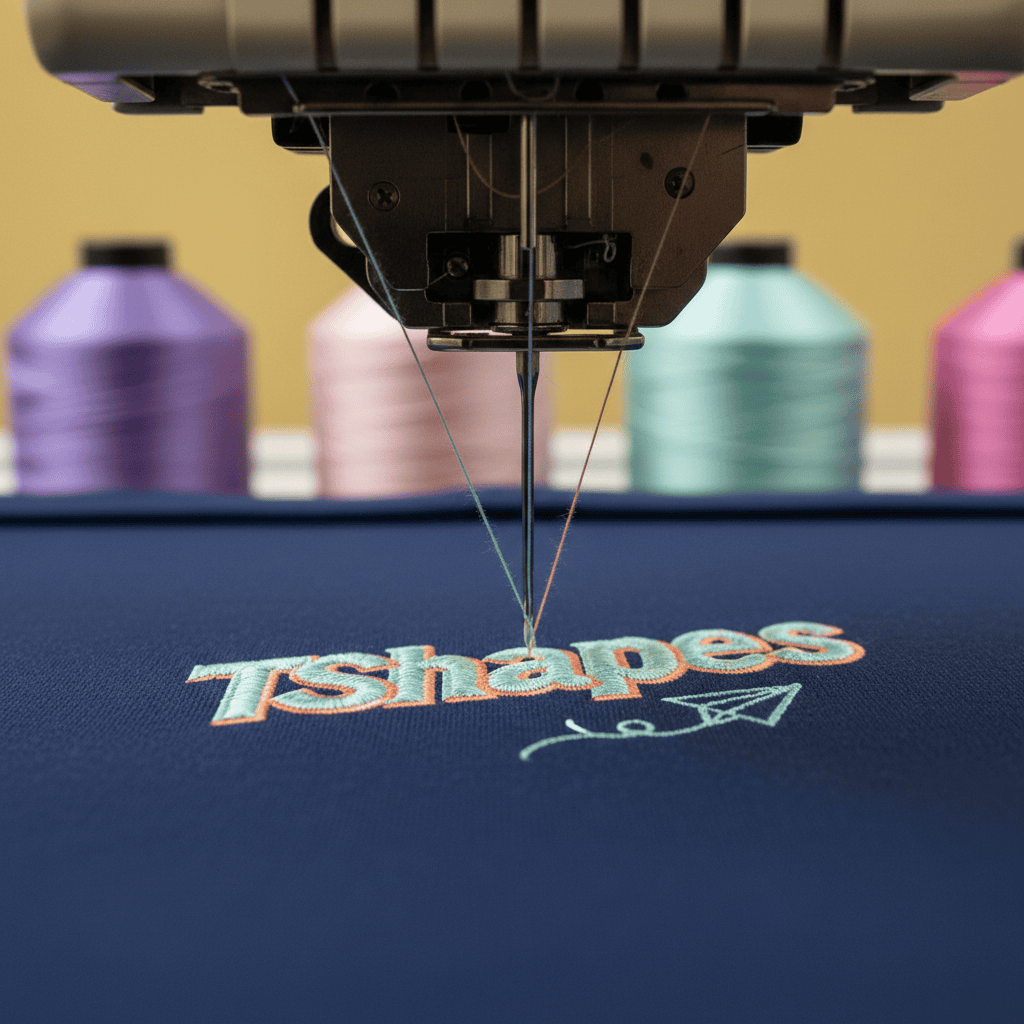
For embroidery there is an extra step called digitising, where the artwork is converted into stitch instructions telling the machine the path, direction and density of every stitch. It is a one-off job per logo — once your design is digitised, every reorder skips it.
2. Garment stock
This is the most common genuine cause of delay and the one nobody can design around. A specific style, in a specific colour, in a specific size can be out of stock at the point you order.
Being flexible on colour, or accepting a very close alternative style, often converts a two-week wait into a same-week job.
3. The decoration itself
The actual printing or embroidery is usually the fastest stage, not the slowest. Machine time per garment is short, and it scales predictably with quantity.
4. Delivery
Add courier transit on the end. Tracked UK delivery is typically a short, predictable window — but it is still a window, and it should be in your plan rather than a pleasant surprise.
Does Embroidery Take Longer Than Printing?
On a first order, usually yes — because of digitising, not because of the stitching.
Once the design is digitised and stored, embroidery and printing sit much closer together on lead time. The difference on a repeat order is often negligible.
Print methods vary a little among themselves too. Screen printing carries a setup stage per colour, which is why it suits larger quantities, while direct-to-film transfers involve less per-order setup and handle detailed multi-colour designs more easily.
None of this changes the headline: on a repeat order with artwork already on file, decoration method is rarely what decides your delivery date. If you want the detail on the embroidery side, our guide to logo embroidery on workwear covers how the process works.

Four Things That Slow an Order Down
In rough order of how often they cause a problem:
- Low-resolution artwork. A logo lifted from a website or a social media profile almost always needs rebuilding. Send the original vector file if you have one, or the highest-quality version you can find.
- Slow proof approval. The proof is sent so you can check it. But a proof that sits unopened for three days has added three days.
- Changing the order mid-production. Adding names, changing a colour or swapping a garment after production has started resets part of the process.
- Incomplete size lists. Waiting on two people’s sizes holds the whole order. Collect them all before you place it.
Notice that three of the four are on the customer’s side of the line. That is not a criticism — it is the good news, because it means the timeline is largely yours to control.
Seasonal Pressure Points Worth Planning Around
Demand for branded clothing is not flat across the year, and neither is garment stock availability.
Late summer into early autumn is busy for school-leaver and staff uniform orders. Autumn brings the shift into fleeces, softshells and jackets, which is when winter garment stock gets tested hardest. The run-up to Christmas adds event and gift work on top.
Spring is generally the quietest window, and it is a sensible time to place a bulk order or get a new logo digitised so it is on file before you need it in a hurry.
If your kit is seasonal, order the winter layers before the cold arrives rather than during the first week of it.
Before You Approve the Proof: Check It Properly
The digital proof is your last chance to change anything without cost, and there is a legal reason that matters more than people realise.
Personalised goods sit outside the standard distance-selling cancellation right. The Consumer Contracts (Information, Cancellation and Additional Charges) Regulations 2013 state that the cancellation provisions do not apply to the supply of goods that are made to the consumer’s specifications or are clearly personalised.
GOV.UK puts the same point in plainer terms for businesses: personalised or custom-made items are among the categories where a refund only has to be offered if the item is faulty.
None of that removes your rights over faulty goods or work that does not match the approved proof. What it does mean is that a garment correctly produced to a spelling mistake you signed off is not a returnable item. It was made to your specification.
What to check on a proof
Spelling of every name and job title. Colours, including whether the logo has been adapted for a dark garment. Placement and size on the garment. Quantities against sizes. Read it as though someone else placed the order.
How Turnaround Works at TShapes
Everything is printed and embroidered in-house at our Alfreton workshop in Derbyshire, which removes the third-party stage that adds days to a lot of orders.
We send a free digital proof before anything goes into production, and our average turnaround is around three days from proof approval on in-stock garments. There is no minimum order quantity, so a small urgent job is not treated as an inconvenience.
If you have a fixed date, tell us at the point of enquiry rather than after the order is placed. It is much easier to build a plan around a deadline than to rescue one. You can see the full range on the custom branded workwear page, or get in touch with your date and we will tell you honestly whether it is achievable.
Ordering & Lead Times — Related Reading
How long does custom workwear take to arrive?
Production time is normally measured from proof approval rather than from the moment you order. On in-stock garments with artwork ready, decoration is typically a matter of days, with courier transit added on top. At TShapes the average is around three days from proof approval.
Why does embroidery take longer than printing?
Only on a first order, and only because of digitising — converting your logo into stitch instructions for the machine. It is a one-off step per design. Once it is done, reorders skip it and embroidery lead times sit close to print.
Can I cancel a custom workwear order once it is placed?
Personalised and made-to-specification goods are excluded from the standard 14-day distance-selling cancellation right under the Consumer Contracts Regulations 2013. Your rights over faulty goods, or work that does not match the proof you approved, are unaffected. This is why checking the proof carefully matters.
What is the fastest way to speed up a workwear order?
Send usable artwork, approve the proof the day it arrives, be flexible on garment colour if stock is tight, and submit a complete size list rather than a partial one. Those four things move the delivery date more than anything happening in the workshop.
Working to a Deadline? Tell Us the Date.
Printed and embroidered in-house in Alfreton, Derbyshire. Free digital proof, no minimum order, tracked UK-wide delivery — and a straight answer on whether your date is achievable.
Written by the TShapes team — printing and embroidering branded workwear in-house from Alfreton, Derbyshire. Published 8 October 2026. Last updated 8 October 2026.
0 Comments