
Hi-Vis Regulations UK: When High-Vis Is Actually Required and What the Classes Mean
There is no single UK law that says “wear a hi-vis vest”. The hi-vis regulations UK employers actually work to are the PPE at Work Regulations, and they turn on one word: suitable. This guide explains what that means in practice, what the classes tell you, and how to brand hi-vis without undoing the thing you bought it for.
Not by name. UK law does not list hi-vis as compulsory for any particular trade. Instead, employers must provide suitable protective equipment wherever a risk assessment identifies a risk that cannot be adequately controlled another way. On most sites and yards, that assessment points straight to high-visibility clothing.
What UK Law Actually Says About Hi-Vis
Most guides open by telling you hi-vis is “a legal requirement on site”. That is a useful shorthand and a poor description of how the rules work.
The duty sits in the Personal Protective Equipment at Work Regulations 1992. Regulation 4 requires every employer to ensure that suitable personal protective equipment is provided to employees who may be exposed to a risk to their health or safety while at work — except where that risk has already been adequately controlled by other means that are equally or more effective. The same regulation places a matching duty on self-employed people to provide their own.
So the question is never “does the law say hi-vis?” It is “has the risk of someone not being seen been controlled another way?” Where vehicles, plant, or poor light are in the mix, the honest answer is usually no — and hi-vis becomes the control.
The Health and Safety Executive puts the emphasis in the same place, noting that the regulations require many factors to be taken into account to ensure that the correct clothing is chosen for a particular task. Choosing a garment is part of the assessment, not a substitute for it.
The 2022 Change a Lot of Small Firms Missed
This is the part that catches out firms who use subcontract or casual labour, and it rarely appears in workwear buying guides at all.
Since 6 April 2022, the Personal Protective Equipment at Work (Amendment) Regulations 2022 extended the existing duties to what the legislation calls limb (b) workers — people on a more casual footing who work under a contract for service rather than a contract of employment.
The practical effect is direct. The HSE explains that where a risk assessment shows a limb (b) worker needs PPE, the employer must carry out a suitability assessment and provide the PPE free of charge, as they do for employees, and remains responsible for its maintenance, storage and replacement.
If you run a site where casual labour comes and goes, that means the box of spare vests is not a favour. It is part of the duty — and it is a good argument for buying branded hi-vis in sensible quantities rather than borrowing whatever is in the van.
What Class 1, Class 2 and Class 3 Actually Mean
Hi-vis garments are graded into classes, and the class is not a measure of quality. It is a measure of how much of you can be seen.
The HSE describes the class of conspicuity as depending on the minimum area of conspicuous materials incorporated into the clothing, with Class 3 being the best and Class 1 the lowest. More fluorescent background fabric and more retroreflective material means a higher class.
How that translates on the ground
A waistcoat carries relatively little material, so it sits at the lower end. A long-sleeved jacket, or a jacket worn with hi-vis trousers, carries far more and reaches the top of the scale. The HSE’s own guidance covers the whole family of garments — coveralls, jackets, waistcoats, tabards, trousers and harnesses — so the choice is wider than the vest most people picture.
The rule of thumb worth remembering
The HSE puts it plainly: the darker the conditions or the worksite, the greater the amount of hi-vis clothing required. For some jobs a waistcoat may be all that is needed. Workers particularly at risk — marshallers and maintenance workers around moving vehicles are the examples given — may need full-body hi-vis so they are as visible as possible to a driver.
Standards for high-visibility clothing are revised periodically, and the certification printed inside the garment is what actually counts. Before a bulk order, confirm the class of the specific garment with your supplier rather than assuming a vest is a vest.
Choosing Hi-Vis That Is Genuinely Suitable
The HSE frames selection as four questions. They are worth running through before you order for a team, because a garment that fails any one of them will end up unworn — and unworn hi-vis protects nobody.
Is it suitable for the risk?
Consider the ambient and artificial lighting where the work happens, and conditions like fog and snow. Where visibility in headlights matters, the garment needs retroreflective material as well as fluorescent fabric — the HSE notes this may mean reflective strips at or below waist level, or strips on trousers.
Is it suitable for the job?
The HSE gives two examples that will be familiar to anyone who has kitted out a team. Loose-fitting tabards can snag on moving machinery parts in warehouses. Hi-vis coats can be far too warm in summer, in which case waistcoats or overalls with the right hi-vis qualities are the better call.
Is it suitable for the wearer?
It should be comfortable, fit properly, and restrict movement as little as possible. This is the quiet reason teams stop wearing kit, and it is the easiest one to fix at the point of ordering by getting the size range right.
Is it compatible with other PPE?
Where two or more types of PPE are worn together they must not interfere with each other. Wet or cold weather clothing in particular should either have hi-vis qualities itself or be capable of being worn under a hi-vis garment — not over the top of one.

Branding Hi-Vis Without Undoing It
Here is where compliance meets the reason you are reading a workwear site. A logo on hi-vis is normal and expected — but where it goes matters, because the class depends on the area of fluorescent and retroreflective material the garment carries.
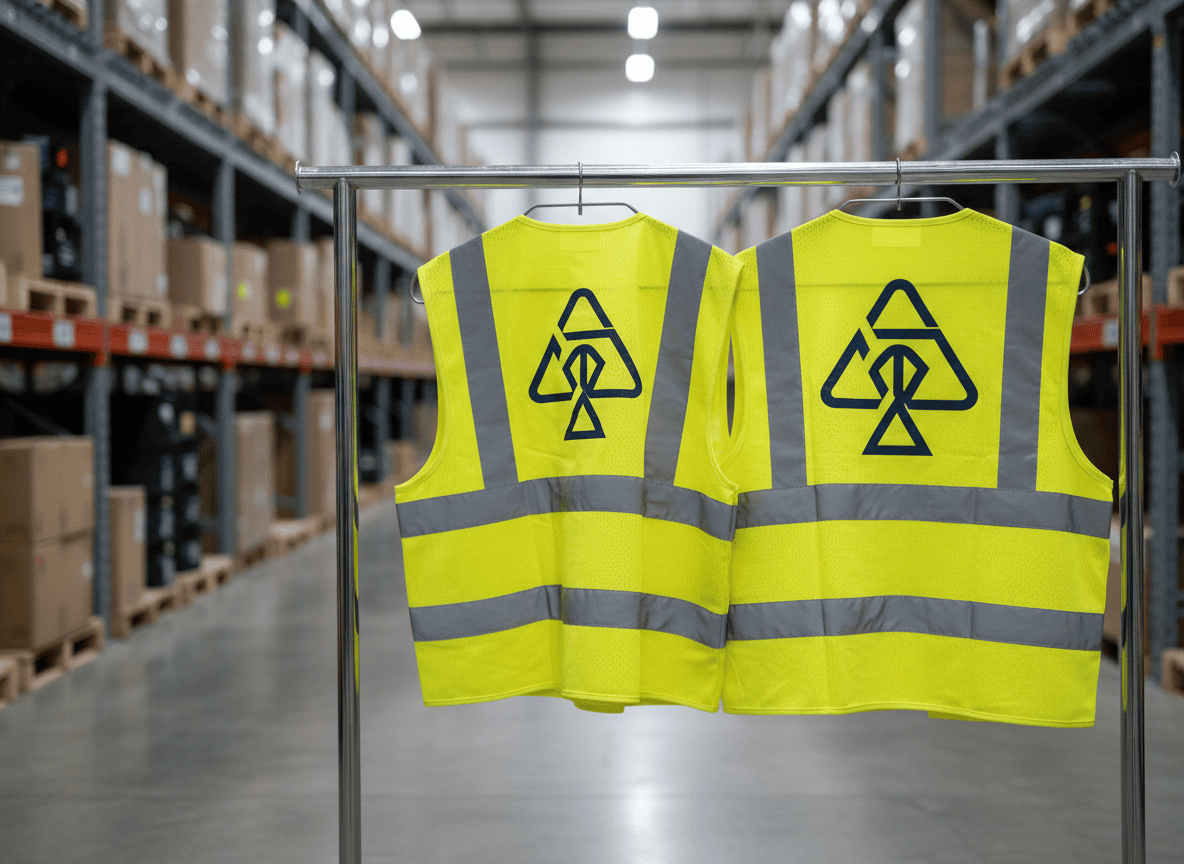
The practical principle follows from that: branding should sit on the garment’s plain fabric panels and clear of the reflective bands. A logo applied over the retroreflective tape covers material the garment was certified with, which is exactly the thing you are paying for.
In practice that usually means a left-chest logo on the fluorescent panel above or below the band line, and a larger company name across the upper back where there is clear space between the bands. On a waistcoat the usable area is smaller than people expect, which is worth knowing before you commit to a wide design.
If you want the detail on placement and method, our guide to putting a company logo on a hi-vis vest covers the ordering side, and the practical hi-vis guide for site teams and contractors covers garment choice across a crew. For kitting out several people at once, printed hi-vis bundles are usually the more economical route.
What Employers Have to Do — and What Workers Have to Do
The HSE sets out both sides plainly, and neither list is long.
Employers must provide any hi-vis clothing needed for the job free of charge to employees exposed to significant risks; keep it clean and in good working order, checking it before it is issued; provide storage for it when it is not in use; give adequate information, instruction and training covering the risks, why the clothing is needed, and how and when to wear it; and supervise workers to make sure it is actually worn.
Workers must wear the clothing as instructed, look after it, report damage or defects, and use the storage provided. As the HSE notes, damaged or ill-fitting clothing will not protect properly — which is a maintenance point as much as a purchasing one.
Ordering Branded Hi-Vis from T-Shapes
T-Shapes prints and embroiders branded workwear from its workshop in Alfreton, Derbyshire, and delivers across the UK. Hi-vis waistcoats and workwear sit in the hi-vis range, and the wider custom branded workwear service covers everything from polo shirts to jackets for the same team.
The team quotes bulk orders from 10 pieces up to 1,000 and beyond, and will advise on whether print or embroidery suits your logo and garment before anything is produced. If you are not sure which class of garment your risk assessment points to, say so when you enquire — it is a better conversation to have before the order than after it.
Frequently Asked Questions
Is hi-vis a legal requirement on UK construction sites?
Not as a named rule. The Personal Protective Equipment at Work Regulations 1992 require employers to provide suitable PPE where a risk cannot be adequately controlled by other means. On a site with moving vehicles or plant, a risk assessment will almost always identify hi-vis as that control — which is why it is treated as standard in practice.
What is the difference between Class 1, 2 and 3 hi-vis?
The class reflects how much conspicuous material the garment carries. The HSE describes Class 3 as the best and Class 1 as the lowest, based on the minimum area of fluorescent and retroreflective material. Broadly, a waistcoat sits low on the scale and a jacket worn with hi-vis trousers sits at the top.
Does an employer have to pay for hi-vis clothing?
Yes. Where hi-vis is needed for the job, the HSE is clear that it must be provided free of charge. Since April 2022 that duty also covers limb (b) workers on more casual contracts, along with responsibility for maintaining, storing and replacing it.
Can you put a company logo on a hi-vis vest?
Yes, and it is very common. Keep the branding on the plain fluorescent panels and clear of the retroreflective bands so the certified material is not covered. Left chest and upper back are the usual positions.
Do self-employed tradespeople need their own hi-vis?
Regulation 4 places a duty on self-employed people to provide themselves with suitable PPE where a risk exists. In practice most sites will also set their own entry requirements, so check what the principal contractor expects before you turn up.
Kit Your Team Out in Branded Hi-Vis
Printed and embroidered hi-vis waistcoats, jackets and workwear bundles — produced in Derbyshire, delivered UK-wide.
Reviewed and signed off by T Shapes. Published 29 September 2026. Last updated 29 September 2026. This guide is general information about UK hi-vis requirements and is not a substitute for your own risk assessment or professional health and safety advice.
0 Comments