
Women’s Workwear That Actually Fits: Ladies-Fit Polos, Jackets and Hi-Vis for Mixed Teams
In a survey of more than three thousand women working across construction, transport, emergency services and engineering, fewer than a third said the protective clothing they wore at work had been designed for women at all. Most branded workwear orders still quietly assume everyone is the same shape.

Short answer: “Unisex” workwear is cut on a men’s block, so ordering a smaller unisex size gives a woman a narrower garment that is still the wrong shape. Ladies-fit garments differ in shoulder width, chest shaping, sleeve and body length and waist-to-hip ratio — order them by style, not by sizing down.

“Unisex” is not a size. It is a men’s block.
This is the thing most buyers never get told. When a garment is described as unisex, it almost always means the pattern was drafted for a male body and then graded up and down. Size down and you get a narrower, shorter version of a men’s garment. The proportions do not change.
In practice that produces a familiar set of complaints. Shoulder seams that sit halfway down the upper arm. Sleeves that cover half the hand. A body that is tight across the chest and loose at the waist at the same time. A hem that either stops in an awkward place or hangs to mid-thigh.
None of that is a comfort quibble. A polo that rides up when someone reaches overhead, or a jacket with sleeves that have to be rolled, is a garment people take off — and workwear that is not being worn is not doing anything for your brand or anyone’s safety.
What the research actually found
This is better documented than most people assume. In a survey run with the Women’s Engineering Society, WISE, the TUC and the Institution of Mechanical Engineers, just 29 per cent of the 3,086 women who responded said the PPE they wear at work was designed for women, and 57 per cent said their PPE sometimes or significantly hampered their work.
The same research named the worst offenders: trousers, overalls, jackets and gloves. That list is telling. They are all garments where the fit problem is structural — length, rise, shoulder geometry — rather than something a different size can solve.
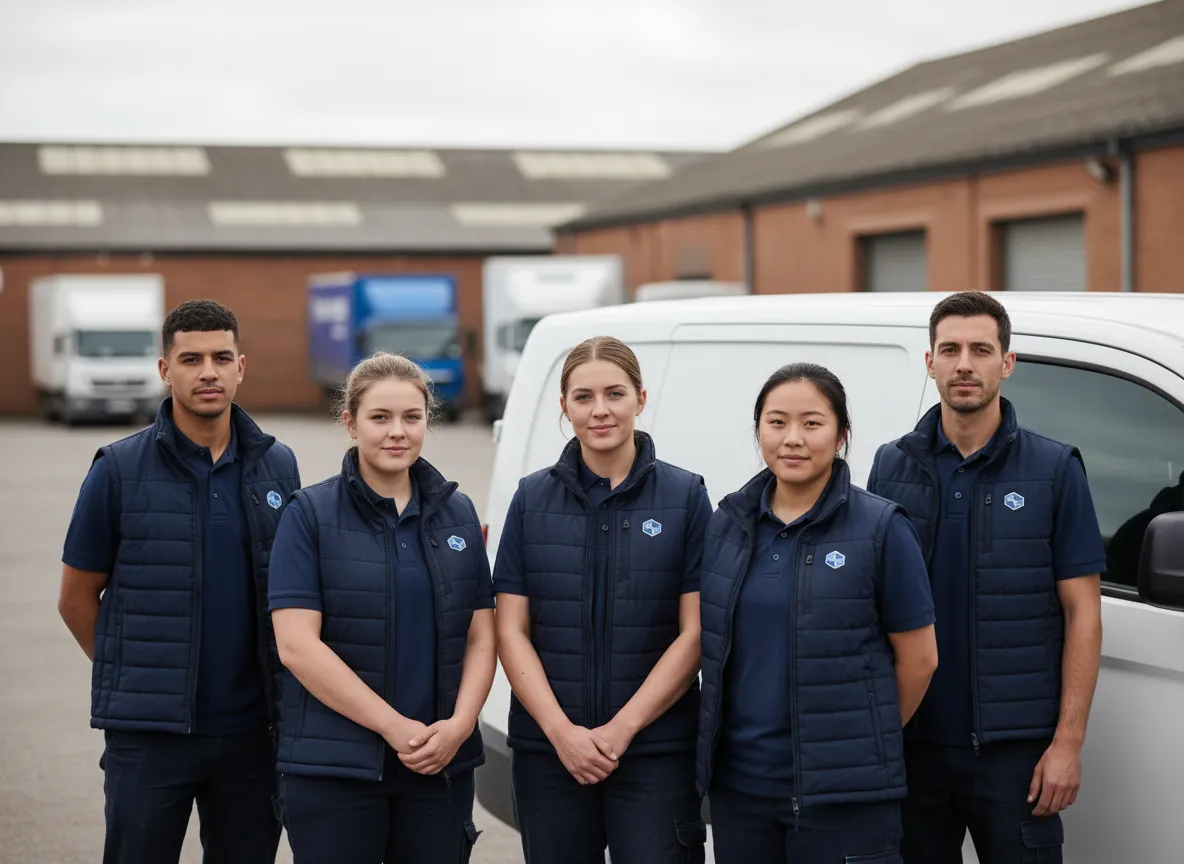
Where ladies-fit genuinely differs
Not every garment needs a ladies-fit version, and pretending otherwise just doubles your stockholding. These are the differences that actually change how a garment wears.
| Feature | Unisex / men’s cut | Ladies-fit cut | Why it matters at work |
|---|---|---|---|
| Shoulder | Wider, straighter seam | Narrower, set further in | Determines whether the sleeve pivots with the arm or drags |
| Chest | Straight through the body | Shaped, with bust darts or a contoured panel | Stops the garment pulling across the front and gaping at buttons |
| Waist | Boxy | Slightly taken in | Keeps the garment out of the way when bending or kneeling |
| Body length | Longer | Shorter, with a curved hem on many styles | Avoids a hem that bunches under a tool belt or harness |
| Sleeve length | Longer | Proportionally shorter | Rolled sleeves are a snag hazard around machinery |
| Collar and placket | Wider, buttons left over right | Narrower, often reversed placket | Cosmetic, but it is what makes a polo look tailored rather than borrowed |
Garments where the difference is worth ordering: polo shirts, blouses and shirts, softshells, fleeces, sweatshirts, trousers and anything worn as a close layer. Garments where a good unisex option is usually fine: loose over-layers, tabards, and most bodywarmers — though even there, a shorter body length helps.
The PPE problem, and why “we’ll take it in” is the wrong answer
Once you move from branded polos into protective clothing, fit stops being a preference. HSE guidance on selecting PPE says to choose equipment that suits the worker, taking account of the size, fit, compatibility and weight of the PPE and the physical characteristics of the user — and states plainly that modifying PPE to fit is not a suitable solution.
That last clause rules out a lot of common workarounds. Hemming trousers, taking in a jacket, taping up sleeves, wearing a vest over a coat because nothing closes properly — none of those are fixes. They are signs the wrong garment was ordered.
Hi-vis is the clearest example. A hi-vis garment works by presenting a certain amount of fluorescent and reflective material in the right places on the body. A garment that is the wrong length or sitting off the shoulder does not present that material where it was designed to sit. Ladies-fit hi-vis exists precisely for this reason, and it is far more widely available than it was even a few years ago.
Worth checking before your next order: whether the hi-vis you currently issue is available in a ladies-fit version from the same range. Staying within one range keeps the shade consistent, which matters once garments start ageing at different rates.
The temporary fit problem nobody plans for
Fit is not a fixed property of a person. Bodies change, and workwear policies almost never account for it.
The same Prospect research found that 11 per cent of the women surveyed had worn standard PPE while pregnant, and that half of those curtailed their duties or changed roles as a result. A further 21 per cent had worn PPE during the menopause, and of those, 38 per cent curtailed their duties. Those are not edge cases — on a team of twenty, they are a near certainty over a few years.
You do not need a maternity range on the shelf to handle this well. What you need is a policy that treats a request for a different garment as normal and gets it ordered quickly, rather than as an exception that has to be argued for. In practice that means knowing which styles in your range run generously, keeping the branding file ready so a one-off garment can be produced without a new setup, and not tying replacement to an annual issue date.
It also means accepting the occasional single-garment order. One extra softshell in a different size is a trivial cost against someone quietly deciding the kit is not worth wearing.
Ordering for a mixed team without doubling your admin
The objection we hear most is that offering two fits makes ordering twice as complicated. It does not have to.
Offer a choice, don’t assign one. Let everyone pick ladies-fit or unisex for themselves. Plenty of women prefer a unisex garment for a loose over-layer and a ladies-fit for a polo. Assigning by gender gets it wrong in both directions.
Order samples before the main run. One of each fit in a middle size, passed round the team, settles more arguments than any size chart. This costs one garment and saves a whole reorder.
Keep the branding identical. Same logo, same thread colours, same position where the garment allows it. A ladies-fit polo has a slightly smaller chest area to work with, so the left-breast logo may need scaling — get that agreed once and it applies to every future order.
Order both fits together. Same batch, same dye lot, same setup. Splitting the order across two dates is how you end up with two slightly different navies on the same team.
What we’d actually recommend
If you are kitting out a mixed team from scratch, start with the garments people wear every day and get those right. A branded polo shirt is worn more hours than anything else in most wardrobes, so it is the garment where fit pays back fastest. Outer layers can be more forgiving.
Then be honest about the roles. Care, hospitality, cleaning, veterinary, retail and office teams are often majority female, and ordering those uniforms on a men’s block by default is simply a mistake — our guides to workwear for care home staff and corporate clothing for office teams both assume a mixed team from the start.
And do not treat this as a favour you are doing anyone. A team wearing clothing that fits looks sharper in photographs, on site and in front of customers. That is the entire point of putting your logo on it.
Frequently asked questions
Is women’s workwear just a smaller version of men’s?
No. A ladies-fit garment is cut on a different pattern block — narrower shoulders, shaping through the chest and waist, shorter body and sleeve. Ordering a smaller unisex size only makes the garment narrower; it does not change the proportions.
Can you get ladies-fit hi-vis?
Yes, and availability has improved a lot. Ladies-fit hi-vis vests, jackets and polos are made by most of the mainstream workwear brands. Because a hi-vis garment relies on material sitting in the right places on the body, fit matters more here than on any other garment.
Do ladies-fit polo shirts come up small?
They often feel smaller than the same nominal size in unisex, because the cut is closer through the body rather than because the sizing is wrong. If people want a relaxed fit, sizing up one is normal — which is exactly why a sample garment beats guessing.
Can we order ladies-fit and unisex garments in the same order?
Yes, and you should. Ordering both fits in one batch keeps the colour, fabric and branding consistent across the team, and it is usually cheaper than running a second setup later.
Kitting out a mixed team?
Tell us the roles and the head count and we will put together a ladies-fit and unisex option in the same range, with the same branding, so the whole team matches. We print and embroider in-house in Alfreton.
0 Comments