
When to Replace Hi-Vis: Wash Cycles, Fading and What the Care Label Is Telling You
A hi-vis vest never stops working on a particular date. It fades a little more each month in the sun, the reflective tape clouds a little more with every wash — and then one evening a driver picks the wearer out half a second later than they should have.

Short answer: Replace hi-vis when the fluorescent fabric has visibly dulled against a new garment, when the reflective tape has cracked, clouded or started lifting, or when the garment has passed the maximum number of washes printed on its own care label — whichever comes first. Damage and fading, not age, are the trigger.

The number on the care label almost nobody reads
Every hi-vis garment you buy carries a care label, and on most of them there is a washing symbol with a number next to it. That number is not a suggestion about laundry frequency. It is the manufacturer telling you how many wash cycles the garment was tested to and still performed at.
This is the bit that surprises people. A hi-vis jacket is a piece of tested safety equipment, and the thing being tested is optical performance — how bright the fluorescent background stays and how much light the reflective tape bounces back. Both degrade. Washing is one of the main things that degrades them.
So before you write a replacement policy, go and read the label on the garments your team is actually wearing. Two vests that look identical on a shelf can carry very different numbers, and the cheaper one is usually the one with the lower figure.
What actually wears out on a hi-vis garment
There are two separate materials doing two separate jobs, and they fail in different ways.
The fluorescent background is the yellow or orange fabric. It works in daylight and at dusk by re-emitting ultraviolet light as visible colour. What kills it is UV exposure and grime. A vest that has spent a summer on a scaffold will have gone noticeably flatter and more lemon-yellow than a new one from the same box.
The retroreflective tape is the silver banding. It works at night, in headlights, and it is the part most people underestimate. Tape fails by cracking along fold lines, clouding over with fine grit and detergent residue, delaminating at the edges, or simply being covered up by paint, plaster, silicone or mud.
A useful habit: keep one unworn garment in the store as a reference. Comparing a working vest against a brand-new one takes five seconds and removes all the guesswork about whether something has “gone a bit dull”.
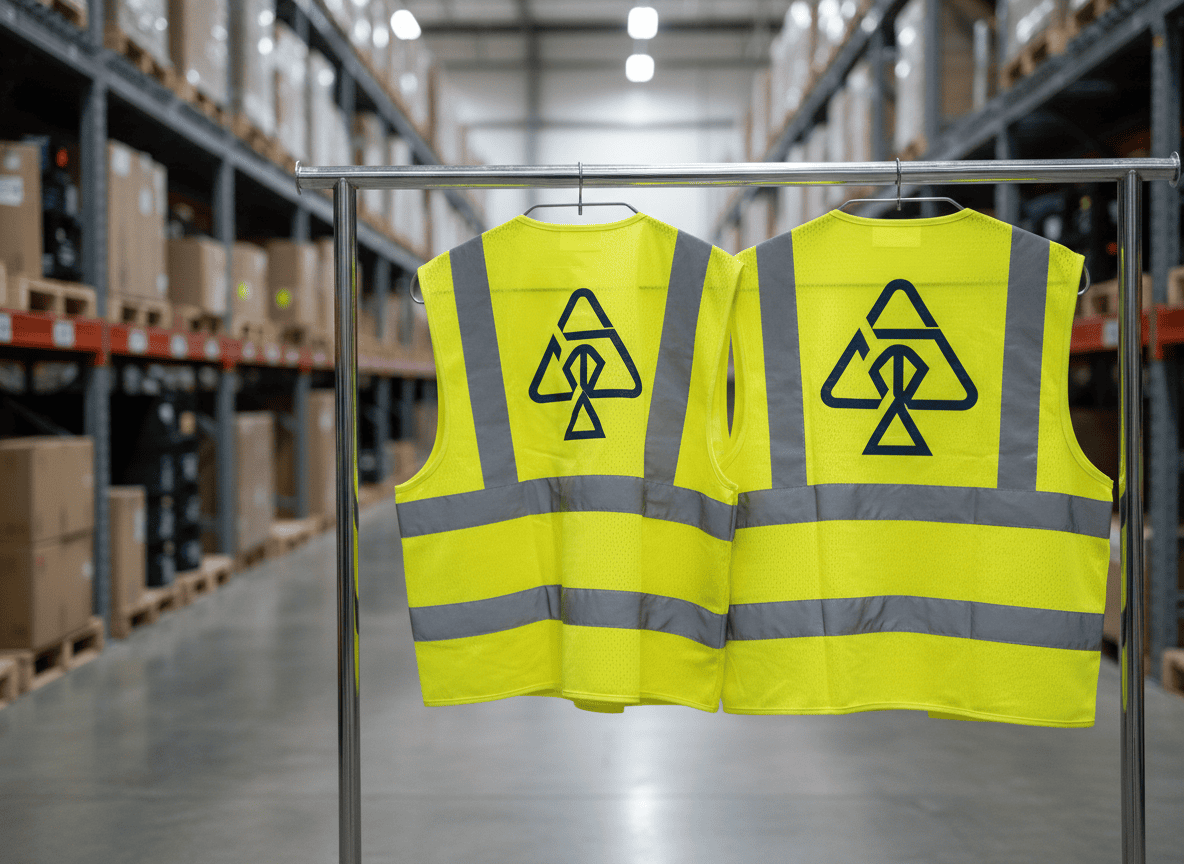
The two-minute inspection any supervisor can run
You do not need equipment for this. Hold the garment up in daylight and work through the list.
- Colour: does the fluorescent fabric still look obviously brighter than an ordinary high-street yellow or orange? If it reads as “a yellowish top” rather than leaping out, it is finished.
- Tape condition: flex a band between your fingers. Fine cracking, a milky haze, or edges that have started to peel away from the fabric all mean the tape is no longer reflecting properly.
- Coverage: is any part of the tape or the fluorescent area permanently covered by paint, resin, adhesive or ingrained dirt? Covered area is lost area.
- Damage: tears, burns, missing panels, open seams, a broken zip that stops the garment closing properly — all of these change how much of the garment is actually visible on the body.
- Wash count: has it been through more washes than the label allows? If your laundry is done centrally, this is worth tracking even roughly.
Anything failing on colour or tape gets retired. Not demoted to “the spare one in the van” — retired, because the spare in the van is exactly the one someone grabs on the dark December afternoon when it matters most.
Where the legal duty actually sits
Hi-vis supplied as personal protective equipment is not just kit; it is regulated kit. The Personal Protective Equipment at Work Regulations 1992 require that every employer ensures PPE is maintained, including replaced or cleaned as appropriate, in an efficient state, in efficient working order and in good repair. Replacement is named in the regulation itself. It is not an optional extra to maintenance — it is part of it.
HSE guidance is blunter still about hi-vis specifically, noting that hi-vis jackets, trousers and coveralls must be cleaned regularly so the retroreflective strips continue to be easily identifiable. That sentence quietly does a lot of work. It means a filthy hi-vis is a compliance problem, not just a scruffy one — and it means “we issued them two years ago” is not an answer.
Since April 2022 the same duties have applied more widely than many small firms realise, following the extension of the regulations to cover a broader definition of worker. If you are issuing hi-vis to casual or contracted people on site, the extended scope of the PPE at Work Regulations is worth ten minutes of your time.
Washing hi-vis so it reaches the life it was sold with
Most hi-vis dies early, and most of the time the washing machine did it. A few habits genuinely extend the usable life:
- Wash it separately. Hi-vis washed in with heavily soiled overalls picks up the dirt those overalls shed. Grey grime on fluorescent fabric is the fastest way to lose brightness.
- Keep the temperature down and follow the label rather than the habit. Heat is hard on the adhesive holding reflective tape to fabric.
- No bleach, no strong stain removers. Optical brighteners and chlorine attack the fluorescent dye directly.
- Skip the fabric softener. It leaves a film that dulls both the fabric and the tape.
- Avoid a hot tumble dry and never iron over the tape. Air drying is slower and much kinder.
- Don’t fold along the tape. Repeated creasing in the same place is what produces those fine cracks. Hang it.
The general principles overlap with looking after any branded garment, and our guide to washing printed and embroidered workwear covers the decoration side in more detail. Hi-vis just has less margin for error, because a dull logo is a cosmetic problem and dull tape is a safety one.
Building a replacement plan instead of reacting to it
The teams that handle this well do not inspect everything every week. They do three things.
They set a review point, not a lifespan. Pick a date — the start of the clock change is a good one, because that is when night visibility suddenly matters again — and run the two-minute inspection across the whole team on that day.
They buy in sensible batches. Ordering the whole team’s hi-vis at once means everything ages at the same rate and gets replaced at the same time, which is far easier to manage than a wardrobe where every garment is on its own schedule. It also means the shade matches, which matters more than people expect once garments start fading at different rates.
They keep a small buffer. Two or three spare vests in the right sizes stops a failed inspection turning into someone working in a garment that should have been binned.
In our experience supplying site teams across Derbyshire and the East Midlands, daily-wear hi-vis rarely stays convincingly bright for as long as people assume. Vests worn over other layers and washed weekly go first; jackets that only come out in bad weather last considerably longer. Judge each garment on what it looks like, not on when it was bought.
Branding, and the one thing not to do when you replace
Replacing kit is the natural moment to get the logo right, and it is also the moment teams accidentally undo the garment they have just paid for. Logos on hi-vis have to work around the fluorescent area and the tape rather than through them. We cover the detail in our guide to what you can and cannot print on hi-vis, and there is broader context in our hi-vis workwear and site safety guide.
The short version: keep branding off the reflective bands, keep it out of the minimum fluorescent area the garment needs, and take the placement advice rather than insisting on a spot that looks good on a mock-up. If you are replacing a batch anyway, it costs nothing to do it properly.
Frequently asked questions
How often should hi-vis clothing be replaced?
There is no fixed interval in law. Replace on condition — visible fading of the fluorescent fabric, cracked or clouded reflective tape, permanent contamination, or the garment exceeding the wash count on its care label. Daily-wear garments reach that point far sooner than occasional-wear ones.
Is faded hi-vis still compliant?
Not meaningfully. The garment’s performance depends on the brightness of the fluorescent background and the reflectivity of the tape, so once either has degraded the garment is no longer doing the job it was certified to do. HSE guidance specifically requires hi-vis to be kept clean enough that the retroreflective strips stay easily identifiable.
Can you wash hi-vis in a normal washing machine?
Usually yes, if the care label allows it. Wash it separately from heavily soiled work clothing, keep the temperature to what the label states, skip bleach and fabric softener, and air dry rather than tumble drying. Every hot wash costs you some of the garment’s remaining life.
Does a printed or embroidered logo shorten the life of a hi-vis garment?
A correctly placed logo does not shorten the garment’s working life — but a badly placed one reduces how much compliant fluorescent and reflective area is left from day one. Branding should sit clear of the reflective bands and inside the areas the garment can spare.
Time to replace the team’s hi-vis?
We print and embroider hi-vis in-house in Alfreton, so we can tell you where your logo can go before you order rather than after. Send us the artwork and the head count and we will sort the rest.
0 Comments